Pages

Tampilkan postingan dengan label ACORN. Tampilkan semua postingan

Selasa, 19 Februari 2013

Next City's long look at the Atlantic Yards CBA: "Brooklyn Dropped the Ball" (but that's not the half of it)

The online publication Next City yesterday published a long article (subscription-only) on the Atlantic Yards Community Benefits Agreement (CBA), headlined Selling Low, Building High: How Brooklyn Dropped the Ball on the Biggest Negotiation of Its Life.

There's some useful stuff--CBA Chair Delia Hunley Adossa won't talk, nor will her sidekick Charlene Nimmons. And the piece pronounces:
Seven years after the Brooklyn document was signed, five of the groups have been mostly silent or reconstituted after without much fanfare.
But it still falls short.

My comment

Here's the comment I posted:
It's good that Next City has tried to provide a broad look at the Atlantic Yards Community Benefits Agreement (CBA).
But even the moderately skeptical tone of the article doesn't address the drama and mendacity behind the CBA--or recognize the consistent criticisms of the CBA that came in real time (from groups like Develop Don't Destroy Brooklyn and my Atlantic Yards Report coverage) as the project unfolded.
Particularly missing is a recognition of how developer Forest City Ratner orchestrated it all--so much so that, in a dismayingly misguided front-page article in October 2005, a New York Times reporter would declare that the developer had conjured up a "modern blueprint" to nourish and harvest community support.
http://atlanticyardsreport.blo...
Note that despite regular promotional statements claiming "community commitments" were "guaranteed by a legally binding Community Benefits Agreement," the CBA presents the targets as aspirational:
http://atlanticyardsreport.blo... 
Why not ask Forest City how much the developer paid all the signatories?
Or point out that, when Forest City was trying to suggest the CBA was legitimate, it claimed--only to rescind it after protest--that the appointed Community Boards participated in "crafting" the CBA:
http://atlanticyardsreport.blo...
Even the subtitle--"How Brooklyn Dropped the Ball..." sets up a false frame: "Brooklyn" never had a chance to negotiate anything. The whole point of the CBA was to set up a facade of community support while the project evaded the existing--if problematic--land use process, involving advisory votes by the local community boards and a vote by (and debate in) the City Council.
As I commented last November on Next City, Bettina Damiani of Good Jobs New York in 2005 told the City Council, before the CBA was signed, that this CBA--which featured only groups that already supported the project--had significant differences with more legitimate CBAs negotiated in Los Angeles:
http://nextcity.org/daily/entr...
While Next City does mention "indicators" that the Atlantic Yards CBA "will yield a different result" than the pioneering Staples CBA, some crucial detail is missing. Not only  was the coalition in Los Angeles larger, it involved the City Council as signatory, thus ensuring more oversight, and addressed some yet unresolved issues regarding Atlantic Yards debate, such as residential parking permits, an issue (still) important to the arena's immediate neighbors (mostly middle- and upper-class) but less important to the CBA signatories (mostly working- and middle-class, living farther away).
http://atlanticyardsreport.blo... 
Or take the glancing mention of the "potential for... possibly a long-promised compliance monitor." That obscures the fact that, when the CBA was signed, backers like Bertha Lewis cited the Independent Compliance Monitor, funded by Forest City Ratner, to oversee implementation. Forest City has remained unaccountable, offering weak explanations and then no explanations for its unwillingness to hire that monitor:
http://atlanticyardsreport.blo... 
Or consider that the "eight community-based groups" were not so "community-based." Only two (or three) were operational in their stated capacities before Atlantic Yards was unveiled in December 2003. As CBA experts have steadily said during the debate over Atlantic Yards, it's a conflict of interest for signatories to take money from the developer that signed the agreement:
http://atlanticyardsreport.blo... 
It's not merely that, "In many cases, the [CBA signatories] gave institutional blessing in exchange for operating funds." That also meant vigorous public backing for Forest City's plan at rallies and meetings, not any contribution to shaping the content of public comments. Consider Delia Hunley- Adossa's MCing of a pro-project rally, steered by Forest City executives, and her description of the environmental commitments her group presumably negotiated: "blah blah blah":
http://atlanticyardsreport.blo...http://atlanticyardsreport.blo... 
There are even more reason to be skeptical of those CBA signatories cited in this article. Consider how Hunley-Adossa publicly understated her compensation from Forest City Ratner by more than 100%
http://atlanticyardsreport.blo... 
Or that Charlene Nimmons, who once claimed incredibly that new residents in Prospect Heights were "the real land grabbers, because they took the [already vacant] property first and turned back what was jobs into condos," was cited just this month by Forest City as playing a particular role in monitoring "us on a regular basis."
http://atlanticyardsreport.blo...http://atlanticyardsreport.blo... 
Or that James Caldwell, though a nice fellow, had no background in job training when he was tapped to head BUILD, and most notably rallied for the project by declaring, more than once, that Bruce Ratner was "like an angel sent from God. 
Or that the Rev. Herbert Daughtry was noted for 1) describing Bruce Ratner (in the developer's publication," aka fake newspaper, the Brooklyn Standard) as having a "customary, humble, winsome manner" and 2) heckling regularly at the one state oversight hearing held regarding the project:
http://www.scribd.com/doc/2836...
http://atlanticyardsreport.blo...
And that the health programs are shunted off to the future and the "meditation room" is pretty much a chair storage area:
http://atlanticyardsreport.blo... 
By the way, Jay-Z tickets were distributed to community organizations. But the eight CBA signatories each got a suite, one for each of the eight nights of concerts. Only Bertha Lewis's organization auctioned it off: http://atlanticyardsreport.blo...
Note that Joe Coello has as a partner in his company Roger Green, the former Assemblyman who was a major architect of the CBA:
http://atlanticyardsreport.blo...
As for Bertha Lewis of ACORN, consider that her training is in theater. Yes, ACORN "was used to getting funds from various sources," but Forest City Ratner *bailed out* ACORN after its institutional funding dried up (because of an internal scandal, not the hyped fake-pimp scam). That's how key ACORN was to Forest City's project, and why ACORN, when it declared bankruptcy, was had the developer as its biggest creditor.
Consider Lewis's rhetoric at two occasions in 2009:
http://atlanticyardsreport.blo..."Bruce Ratner's never wavered," she said. "I never look for anybody else to ensure these guarantees. We look directly to the developer to ensure the guarantees."
http://atlanticyardsreport.blo..."You want to know who’s gonna make sure that the housing is affordable?” she asked. “We will. We’re not going to make sure that some politician takes care of us,” she stated. “We’re not going to stand by and try to have some agency take care of us. ACORN will take care of us.” 
"[W]e would have fought to make this project come about the way we said," Lewis says in this article. In reality, the Affordable Housing Memorandum of Understanding was supposed to set aside 50% of the subsidized units, in terms of floor area, for family-sized units, containing two or three bedrooms. 
The first tower doesn't come close, as I reported, and the small number of two-bedroom units are skewed toward middle-class households, "affordable" but far from ACORN's constituency. Did Lewis raise any criticism? No, she blamed project opponents:
http://www.bkbureau.org/agency...
A couple of more factoids to consider:
--Ratner's seeming generosity in finding an initial place for Kassoum Fofana relied on public funds; city taxpayers reimbursed Forest City $131 million for land
http://atlanticyardsreport.blo... 
--another lens for viewing the artisanal mayonnaise shop: it's half a block from the southeast corner of the "blighted" Atlantic Yards site; do blight and artisanal mayonnaise (as well as cappuccino) really coexist, or does it look like state eminent domain laws allow a rather loose definition of blight?
http://atlanticyardsreport.blo...http://atlanticyardsreport.blo...
I also commented:
At a June 2005 ceremony, as captured in the documentary Battle for Brooklyn, Mayor Mike Bloomberg imperiously dismissed questions about promised housing and jobs in the CBA: “I would add something else that’s even more important. You have Bruce Ratner’s word, and that should be enough."
http://battleforbrooklyn.com/
Four years later, Bloomberg changed his tune. “I’m violently opposed to Community Benefits Agreements,” Bloomberg told The Brooklyn Paper in August 2009. “A small group of people, to feather their own nests, extort money from the developer? That’s just not good government.”
http://brooklynpaper.com/stori...
As it happens, Forest City got very good value for its investment, especially since the only organizations that can enforce the CBA are financially dependent on the developer--and that pesky Independent Compliance Monitor was never hired.


emergency cash loan

Up To $1500 Quick Loan Online. No Hassle. Fast Instant Approval. Withdraw Your Cash. Get Cash Fast Today!

Rating of emergency cash loan


Get Online Application at online payday loans.

Jumat, 30 November 2012

At meeting on first Atlantic Yards tower, questions about affordable housing, CBA oversight, design, safety, parking, noise

The meeting last night at Borough Hall was supposed to address the design for B2, the $183 million, 32-story, modular tower that will be the first Atlantic Yards residential building, but the presentation actually went well beyond it to issues not just of neighborhood impact but also affordable housing and hiring.

Photos and set by Tracy Collins
The session, which lasted only about 90 minutes of a projected two-hour length, was mostly low-key, with handful of flash points, including the questionable claim that a Dean Street sidewalk narrowed to five feet could accommodate arena crowds.

There were perhaps 60 people in the audience, many of them apparently more interested in issues like affordable housing--applications should be available in January 2014--than the impacts of construction. The building will have 363 units, with 181 (50%) subsidized for low-, moderate-, and middle-income renters.

Representatives of developer Forest City Ratner and its associates were mostly surefooted regarding plans for the building, stressing that there should be less noise, fewer deliveries, and a faster construction schedule--all of which should add up to a decreased impact on neighbors near the building on Dean Street just east of Flatbush Avenue bordering the arena.

The design was presented as far more varied than the shorthand "Lego" style used in some press accounts, with significant testing to ensure safety.

Some fuzziness

But they were fuzzy on some controversial issues, such as the actual number of jobs, as well as the amount of larger apartments available for lower-income renters. And, rather than being presented as a cost-saving tactic, the modular plan was explained as an opportunity for innovation--a legitimate but incomplete answer.

“Why did you wait until three weeks before the groundbreaking to present these plans to the community?” one audience member asked, in a question submitted in writing to the moderators, Rob Perris, District Manager of Community Board 2, and Craig Hammerman, District Manager of Community Board 6.

“So we committed to do a groundbreaking by the end of year, so December 18 gets us in there,” Forest City Ratner External VP Ashley Cotton responded, “and we were finalizing plans with our partner Skanska, our financing, and so I guess the timing of all the things, if you line them up, today was a great day to be able to share absolutely everything with you guys, now that it’s all come to fruition.”Forest City Ratner Public Presentation of B2, Nov. 29, 2012

Official backing

In the audience were several officials from Empire State Development, the state agency overseeing Atlantic Yards, including CEO Kenneth Adams and his Chief of Staff, Justin Ginsburgh. Arana Hankin, Director, Atlantic Yards Project for ESD, called it “a really exciting day for all of us.”

“The next chapter of the Atlantic Yards project is upon us. Forest City Ratner has delivered us a spectacular arena,” she said, and there’s “ every reason to believe the first building will be just as impressive.”

Not only would the tower, with 363 apartments, “further change landscape of Downtown Brooklyn,” Hankin declared, it has “the potential to change the construction industry around the world,” given that it would be the tallest building in the world built in modules constructed at a factory and trucked to the site.

Markowitz, with Jane Marshall and Terence Kelly
Borough President Marty Markowitz saluted “the triumphant opening of America's most beautiful arena” and said that the plan to ensure that half of the units will be affordable would be “keeping the promise made by Forest City Ratner and all of those who supported it.” (Not quite, as noted below.)

“With tonight's exciting new announcement, we have opportunity to create... potentially a new industry in Brooklyn,” Markowitz said, suggesting that “modular has the potential to create thousands of jobs.”

Leading off

Melissa Roman Burch, Forest City’s Senior VP for residential/commercial construction, said B2 was nearly in place, given that they’ve established a new modular factory with Skanska and achieved collective bargaining with union labor.
Melissa Burch and Bob Sanna
“All financing commitments are in place with HDC [New York City Housing Development Corporation] and Bank of New York Mellon to permit construction,” she added. (Actually, NYC HDC, which did have its one required hearing this past July, told me yesterday that its board next week will be voting approval of tax-exempt financing of up to $100 million.)

They're still waiting for the New York City Department of Housing Preservation and Development to approve some apartment design issues.

Affordable housing

As described in the chart at right, there would be 75 subsidized studios, 70 1BR units, and 36 2BR units.

Burch noted that every apartment would have a washer and dryer, and the building would have such amenities as a fitness center, game room, and yoga/dance studio.

Given that there are 36 subsidized two-bedroom units and only 12 market-rate units, they skew toward affordability, Burch noted.

(However, that’s still well behind the developer’s promises in the Affordable Housing Memorandum of Understanding signed with ACORN, and was increased only due to pressure from NYC HDC, as I described in an article for City Limits' Brooklyn Bureau.)

The program, she said, was created by Forest City and its Community Benefits Agreement (CBA) partner Mutual Housing Association of New York (MHANY), “and in close partnership with leading Bertha Lewis, Jon Kest, and Ismene Speliotis.”

The latter three were top officials in NY ACORN, which actually signed the housing deal in May 2005. ACORN is now defunct, and MHANY operates as somewhat of a successor.

Unlike in some subsidized buildings, the affordable units will be distributed throughout the entire building. Tenants will be chosen through a city-administered lottery, with applications available in January 2014, approximately six months before the building is expected to get its Temporary Certificate of Occupancy.

All rental apartments, whether market or affordable, will be subject to rent stabilization.

An expansion switch to encompass CB 3?

Burch said that 50% of affordable units will be set aside for residents of Community Boards 2, 3, 6,and 8. That represents an apparent expansion of plans.

In July 2006, when presenting affordable housing plans, Forest City officials said half the units would be set aside for residents of Community Boards 2, 6,and 8--each of which has a part of the 22-acre Atlantic Yards footprint.

In the CBA, the “neighboring community” is defined as encompassing CBs 2, 6, and 8. CB 3 is nearby, and likely includes an even larger percentage of needy people. (I’ll check more on this expansion.)

Who’s eligible?

Burch pointed to a chart showing current eligibility, based on the current federal AMI (Area Median Income) of $83,000 for a family of four.

That AMI, which is based not just on Brooklyn but on more affluent suburban counties, is likely to increase by 2014.

She gave two examples. A single person earning $25,000 would fall into Band 2. The rent for a studio would be $640 a month.

A mother with two kids, earning $50,000 a year, would “fall into Band 5,” she said, the correcting herself to say “Band 3.” That would mean $1,433 for a two-bedroom unit.

Capacity of apartments

What are capacity levels for the units?

Burch said they needed to hear from official agencies, but studios and 1 BR units generally hold one or two people, while 2 BR units could contain households from two to four people.

“Those determinations are part of the applications review process by the city,” she said, and are dealt with on a case by case basis.

Another example: family of 4 < $50K

A moderator read a question: how many units would there be for a family of four making less than $50,000?

“I’m not sure I'll be able to do the quick math,” Burch responded, a bit fuzzily. Given a total of 36 2 BR units, “that would be partially Band 3, and then also Band 2 and Band 1. So I'm not able to do that math to provide specific numbers right here today, but there are units that are set aside to accommodate that.”

Actually, as I described in an article for City Limits' Brooklyn Bureau, of those 36 subsidized two-bedroom units, nine would go to low-income families (Bands 1 and 2) and five to moderate-income ones (Band 3).

However, Band 3 starts at $49,800 for a four-person family and goes up to $83,000, which suggests perhaps only one family earning under $50,000 would be among the five chosen in that Band 3.

(Those numbers could still change, but there is a skew.)

CBA oversight

What role will CBA signatories have in oversight of housing and employment?

Ashley Cotton in center
“We mentioned Bertha Lewis and her colleagues earlier, and this was all done in coordination with them and will continue to be in coordination with them,” responded Cotton.

How will the CBA goals be monitored, read Hammerman.

“They’ll be monitored by our great CBA team; we see representatives here today, and with Forest City,” Cotton said. “And I assume that question’s also directed at when we're hiring an Independent Compliance Monitor, and those plans are still underway.” (That’s been delayed for years, allowing Forest City Ratner to evade such oversight.)

There are no plans to sign a new CBA, Cotton confirmed, responding to a question some thought a bit out of left field. (Then again, job-training signatory BUILD is now defunct, so that capacity is no longer being filled.)

The rest of the housing?

What about the other two residential buildings on the arena block?

Burch said they expect to break ground every 6 to 9 months after a building is completed.

What about affordable ownership, which was part of the agreement with ACORN?

“Right now, we're here to present plans for B2,” Burch said. “I don't have a date or timeline for when those units will be available... we will meet the commitments.”

Regarding issues like senior housing and home ownership, “we wish we had answers too,” Cotton said. “We’ll come to you with future plans as the other buildings unfold.” The project is supposed to include 6,430 apartments, including 4,500 rentals, half of them subsidized.

Where will B2 residents park? 

As noted by Atlantic Yards Watch, the only parking area designated in project documents not currently used for something else is the surface lot in block 1129, and that lot has been nearly full several times during arena events, leaving few existing spaces for future B2 residents.

There will be 146 spaces, both striped at the surface and using stackers, at Block 1129, Cotton said.

Previously, the number of onsite spaces was reduced from 1100 to 541 (plus 24 spaces for place) because, most likely, using stackers for arena patrons would be loud and unwieldy.

Given that residents would enter and leave in a less concentrated manner, stackers may work better for them.

Noise and that pesky bass 

Residents more than a block away have complained that bass from Jay-Z and Sensation concerts has penetrated their homes, and it’s certainly perceivable on the sidewalks outside the arena.

So, how will these units adjacent to the arena be protected from such noise?

“So, we are aware of the music reports,” Cotton said. “and we are currently studying them, and any solutions that are needed will be applied to the arena.”

Supplemental EIS

What is the status of of the Supplemental Environmental Impact Statement (SEIS) ordered by a court to study the community impacts of a potential 25-year project buildout, as opposed to the long-stated ten-year timetable and the potential for a 15-year extended buildout acknowledged in ESD's 2009 re-approval of the project.

“We hope to get out the draft scope of the SEIS before the end of the year," Hankin said, "but this is not really relevant to this discussion.” The SEIS addresses Phase 2, east of Sixth Avenue, not the towers on the arena block.

Open space for residents?

Can there be any temporary open space near the building?

“Right now, open space is really in Phase 2, east of Sixth Avenue,” responded Forest City executive Jane Marshall. “We have temporary open space on B3 [at the northwest corner of Dean Street and Sixth Avenue]. And that’s really all the land we can give to open space, and when B3 goes away, there not be there any more."

How many construction jobs?

“Modular construction will require approximately the same number of man-hours as conventional construction,” Burch said, in a statement that surprised some in the audience. (I’ve expressed skepticism.)

If that’s true, then Forest City would be saving only on compensation per worker, without having fewer workers.

The fabrication facility will be full-time, with approximately 125 union employees, plus 25 supervisors, meaning 150 staff.

Hiring will be done win partnership with job training center at the Brooklyn Navy Yard with a preference to union apprentice programs like NEW, Construction Skills, and Helmets to Hardhats. There will also be a preference for residents of CBs 2, 3, 6, and 8, as well as public housing residents.

The workforce CBA hiring goals remain intact: 35% minority workers and 10% female workers.

Sharples (l.) and Farnsworth
I submitted a question that was read and responded to somewhat quizzically: “How many construction workers, in job-years, are needed to build the building.”

“I can't tell you,” Cotton responded.

That term job-years, however, has been the way Atlantic Yards construction jobs have long been described and projected: 15,000 jobs = 15,000 job-years.

Design and construction issues

Architect Chris Sharples of the firm SHoP said that, when the first started on B2 some 2.5 years ago, it was  a conventional building. “It was a surprise to take this and transform it into a modular one.”

They still had to address design guidelines, breaking down the massing, which he described as “a series of three volumetric setbacks,” including “white cube” and “the wedge, along Flatbush.”

Each has a different look. The white cube has a perforated metal mesh, while the upper segment has a beveled frame in which “the metal panels stick out and project off the facade,” painted pewter and silver gray, colors expected to change.

Building modular requires architects to conceal the “mate lines” between the modules. Joints are covered by millwork, or wood oak flooring. Some 90% arrives factory finished, including floor finishes, electrical appliances, mechanical equipment, and even the facade. “The idea is to bring a high quality finished product to the construction site.”

Still, they’re able to open up the “mods” and create larger spaces, he said.

David Farnsworth of the engineering firm Arup said the building is up to the same code standards as a conventional building, and the structural system has been vetted through an independent peer review, by the firm Thornton Tomasetti. 

The wind loading and responses have been confirmed through wind tunnel testing.

Everything at the first floor and below will be built just like a regular building, with a hole dug for the basement and a concrete substructure. The ground floor will have steel beams and concrete floor steps 
A steel platform will be used to stack the modules.

Because the modules are fully finished, the building will appear “pretty much complete,” floor by floor.

Farnsworth said six modules were tested, and scale models were tested in a wind tunnel. 

Forest City construction chief Bob Sanna said the team did visit the current tallest building, a 25-story tower in the UK, which, unlike B2, has a concrete core. “They did have tolerance issues,” he said.

The benefits of modular

Sanna said the building would take only 20 months to build (from the time excavation began), rather than, as once projected, 30 months. That’s because module fabrication occurs at the same time site work occurs.

The chassis of the modules, he said, would be fabricated in Fredericksburg, VA. At the factory at the Brooklyn Navy Yard, the modules will be created.

Burch said modular should mean less noise and fewer deliveries, as well as a safer work environment for workers. Detailed production drawings mean less waste.

The modules, no greater than 50 feet wide and between 20 to 50 feet in length (and typically closer to 30 feet), will be shipped by truck during the day. Eight to 23 modules will be delivered between rush hours, taking a route from the Navy Yard to the site, down Flatbush Avenue.

One module will be delivered at night and stored overnight, so early morning crews can work on it. "This project doesn't contemplate any actual work after hours," Sanna said.


Why modular?

What the motivated the decision to go modular?

"We talked about a lot of benefits," Cotton said, referring to speed and less neighborhood impact. "We're also excited about a new manufacturing industry here in Brooklyn... This factory could be very busy."

All true, but as Forest City stated in another industry presentation (above), the motivation also includes cost savings, price certainty, and risk mitigation.


emergency cash loan

Up To $1500 Quick Loan Online. No Hassle. Fast Instant Approval. Withdraw Your Cash. Get Cash Fast Today!

Rating of emergency cash loan



Get Online Application at online payday loans.

Kamis, 04 Oktober 2012

Updated: Bertha Lewis's Black Institute auctioning suite access to Jay-Z to raise $25,000; all CBA signatories got free suites

Signatories of the Atlantic Yards Community Benefits Agreement (CBA), and/or the organizations they now run, are getting access to Barclays Center suites, and at least in one case, have been auctioning them off to raise money.

Bertha Lewis, head of the now-disbanded ACORN, now heads the Black Institute, which offers this "Adopt-A-Dreamer" opportunity for tonight's show:
President & Founder Bertha Lewis
Cordially invites you to support The Black Institute's "Adopt a Dreamer" Program by joining us for a Jay-Z concert at Brooklyn's Barclay Center. Don't miss this opportunity for you and your guests to enjoy this landmark event from the comfort of a luxury suite. 
October 4, 2012
Barclay Center, Suite Level
7:00pm
$2,500 per ticket
$25,000 for entire suite
Suite amenities include access to suite level VIP lounges, tickets to concert, plush leather seating, mini wet bar and kitchen - perfect for food prep and bar set-up.
Updated with Daily News article

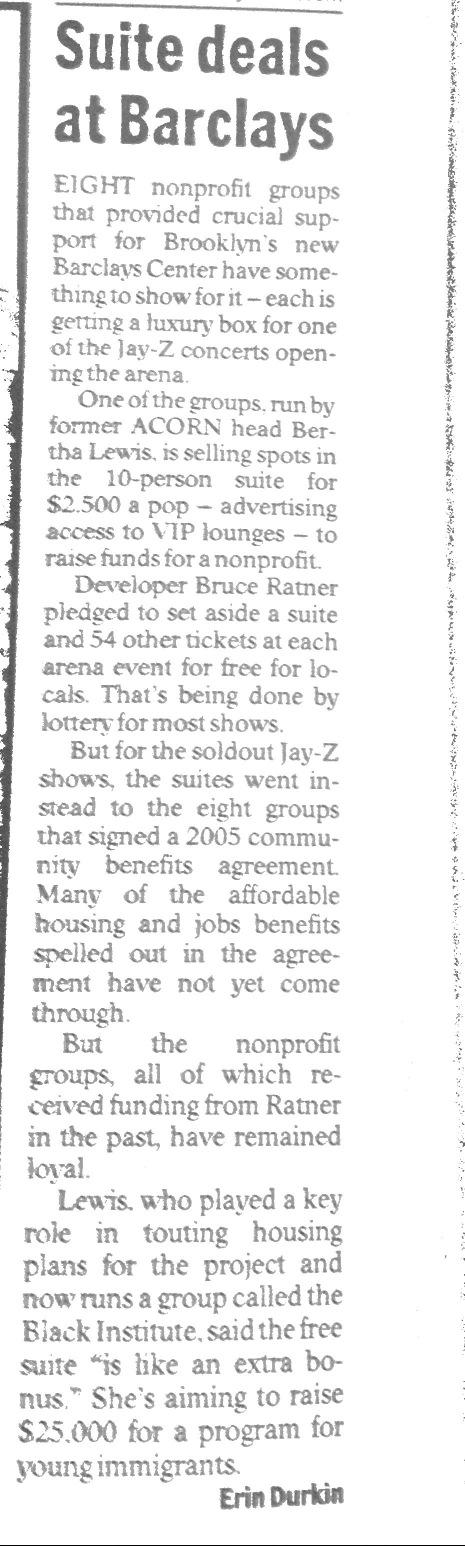
Erin Durkin of the Daily News got the story first, reporting (in an article not online) yesterday that each of the Community Benefits Agreement signatories got access to a Barclays Center suite for each of the Jay-Z concerts.

This is part of a pledge to set aside a suite for each arena event for community access--only this time, they go as rewards to the signatories. As Durkin noted:
Many of the affordable housing and jobs benefits spelled out in the agreement have not yet come to fruition.
But the nonprofit groups, all of which received funding from Ratner in the past, have remained loyal.
That last sentence seems rather self-explanatory.


emergency cash loan

Up To $1500 Quick Loan Online. No Hassle. Fast Instant Approval. Withdraw Your Cash. Get Cash Fast Today!

Rating of emergency cash loan


Get Online Application at online payday loans.

Copyright © 2014. Gorjao Business - All Rights Reserved
Home | About loan | new loan | loan pathner